
🧭 SaugaTech Compass #23 — The Price of Intelligence: What AI Is Really Costing Our Communities

Hi SaugaTech Community,
It’s been a little while since the last Compass landed in your inbox.
Life happened — for a lot of us in the volunteer group at once. Work sprints, family commitments, a hospital trip or two. The WhatsApp group kept buzzing the whole time, which tells you everything about this community. But sitting down to write something that does this community justice takes time and a certain kind of headspace. We needed both.
We’re back. And we’re starting with a question that’s been sitting quietly underneath every AI conversation we’ve had this year — and recently surfaced in the WhatsApp group with some real heat.
How much is all of this actually costing us?
Not in dollars.
In water.
In electricity.
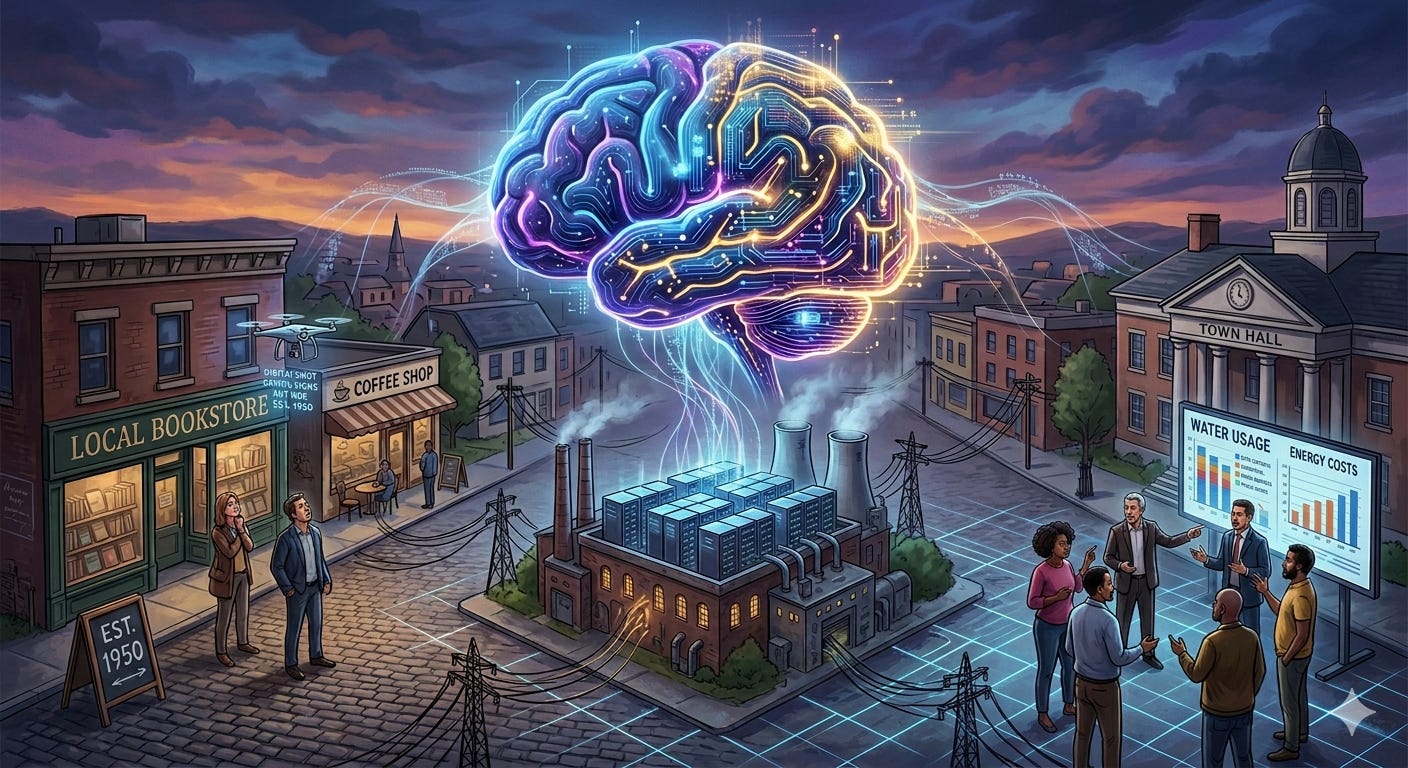
In the quality of life of communities that never asked to host the infrastructure powering the AI revolution — and are now finding out what that means for their energy bills, their water supply, and their neighbourhoods.
Here’s what pushed this to the top. Last week, Pope Leo XIV released Magnifica Humanitas — his first major theological document, devoted entirely to AI. The leader of 1.3 billion Catholics warned that control of AI must not remain in the hands of “a few,” called for rigorous ethical constraints on its use in warfare, and argued that the technology is actively fuelling global conflict. He called for the “disarming” of AI. Warned that “new forms of slavery” are tied to its rise. Cautioned against a race for ever more powerful algorithms driven by “the desire to secure geopolitical or commercial dominance.”
You don’t have to be Catholic — or religious at all — to find this significant. The moral leader of the world’s largest religious institution didn’t choose climate change, poverty, or conflict as the defining issue of his papacy. He chose AI. Because the question he’s actually asking isn’t a theological one. It’s a human one.
What are we willing to pay for this? And who decides?
Grab a coffee. Let’s get into it.
🚀 First Things First: June 20 Meetup
We’re back with our next meetup on Saturday, June 20 at IDEA Mississauga, Square One.
We’re still shaping the topic and format — and we want to hear from you. What do you want to learn, debate, or build? If you have something to share — a project, a perspective, hands-on experience with AI tools — we’d love to hear from potential facilitators too.
Reach out at saugatechproduct@gmail.com or drop a message in the SaugaTech WhatsApp Group (Note please email or message us on +14377992290 if you want to be added to the whatsapp group)
This community grows when you bring your ideas into the room.
The Infrastructure Underneath Everything
Before we get into costs, it helps to have a sense of what we're actually talking about.
Every time you run a prompt, generate an image, ask an AI to review your code — somewhere, a data centre processes that request. Servers, GPUs, cooling systems, power infrastructure. None of the things we talk about in this newsletter exist without them.
And they are growing at a pace most people haven’t reckoned with.
According to the IEA, global data centre electricity consumption in 2024 was roughly 415 terawatt hours — about 1.5% of all the electricity consumed on earth. That number is growing at four times the rate of global electricity consumption overall. By some projections, data centres could consume more electricity by 2026 than Japan does today.
In the U.S., data centre energy demand is expected to nearly double between 2025 and 2028. That’s the energy equivalent of adding an entire Spain to the grid in three years.
Closer to home: Ontario’s grid operator projects commercial data centre demand in the province will grow more than 400% by 2050. There are already 94 data centre locations across Mississauga and the broader GTA — one of Canada’s densest clusters — with more development spreading through Markham, Etobicoke, and Cambridge.
The community most of us call home is already at the centre of this story.
Three Costs That Don’t Show Up anywhere
Here’s the thing about how data centres get discussed: the conversation almost always stays at the level of the company building them. Their capital investment. Their energy contracts. Their sustainability pledges. What gets far less attention is what happens to everyone else in the vicinity — the costs that fall outside the transaction entirely.
There are three that are worth understanding clearly.
The grid is shared — and upgrades aren’t free. When a hyperscale data centre connects to the provincial grid, it draws on transmission infrastructure built over decades by ratepayers. The new capacity required to serve that demand has to be built — and in most jurisdictions, those upgrade costs get distributed across all electricity users, not billed to the company that triggered the need. The result is visible in the data: electricity prices in U.S. regions with high data centre density jumped 267% over five years, well above the national average. Nearly three-quarters of voters in Virginia — where data centres are heavily concentrated — now blame the facilities directly for their rising energy bills. The companies paid their contracts. Their neighbours paid for the grid to grow.
Water isn’t a utility you can scale. You can build more transmission lines. You can’t manufacture more groundwater. Data centres use enormous volumes of water to cool their servers — and in many regions, that consumption competes directly with agricultural use, municipal supply, and local ecosystems. The numbers are hard to pin down precisely because most tech companies don’t disclose water use at a facility level, but researchers estimate that a single AI chatbot conversation — 10 to 50 responses — uses roughly half a litre of water. At the volume AI now operates, that stops being a rounding error. Amazon’s Project Rainier in Indiana — one of the largest AI facilities ever built — drew so much water during construction that nearby residents reported their wells running dry. Indiana state officials opened a formal investigation. Amazon paid its water bills. The neighbours lost access to their water supply.
Community disruption doesn’t appear on a balance sheet. Land gets acquired, permits get filed, construction begins. The communities living closest to these facilities — often rural, often lower-income, often communities of colour or Indigenous communities — rarely have meaningful input into whether they want to host this infrastructure, or on what terms. No invoice captures that cost. No sustainability report accounts for it. It simply falls on the people with the least power to object.
These three costs — shared grid burden, water as a commons, and the absence of consent — are the actual mechanism behind Pope Leo’s concern. Not that AI companies are villains. But that a system optimised for private benefit can generate public costs that no one explicitly agreed to bear.
The Canadian Picture
Canada is moving aggressively to build AI infrastructure, and the rationale is genuine. Ontario, Quebec, Alberta, and BC are treating data centres as core national infrastructure — turning AI strategy from policy documents into physical construction.
But the Canadian story has its own version of the same tension.
Kevin O’Leary’s proposed data centre in drought-stricken Alberta was put forward without the consent of an affected First Nation. In Alberta more broadly, data centre growth risks driving up power costs if new gas plants or transmission upgrades run over budget — with tech companies potentially locking in favourable rates that shift the cost of grid expansion to general ratepayers. Calgary restricted water use in both 2025 and 2026. The Alberta Utilities Commission dismissed one data centre proposal in March 2026, citing unresolved questions about whether its requirements had been met.
Ontario responded with Bill 40 — requiring data centres to obtain approval before connecting to the grid, ending automatic sign-off for large energy-intensive loads, and prioritising projects that deliver measurable community benefits, create quality jobs, and support data sovereignty. It’s a meaningful shift in who gets to ask questions before the concrete is poured.
Microsoft, which has committed $19 billion in Canadian data centre investment between 2023 and 2027, has explicitly promised to cover the full cost of electricity including new generation and grid upgrades — and to minimise water use — in direct response to community pressure. That’s a real commitment. It’s also a signal of how hard communities had to push to get it.
The Question Underneath All of This
Here’s the tension Pope Leo was actually pointing at.
AI is delivering real benefits. Drug discovery is accelerating. Climate modelling is improving. Diagnostic tools are reaching patients who previously had no access to specialist care. The productivity gains for engineers, writers, researchers, and builders are real and compounding. None of that should be dismissed.
But the infrastructure powering those benefits is generating costs that fall on communities who didn’t choose to bear them — through shared grids, shared water tables, and shared land. The mechanism isn’t malice. It’s a governance gap: the rules haven’t kept pace with the scale of the buildout.
“It is not enough to invoke ethics in the abstract; robust legal frameworks, independent oversight, informed users and a political system that does not abdicate its responsibility are required.”
Strip the theological framing and what remains is a governance question: who decides how this technology gets built, and who gets a say when the costs land somewhere they didn’t plan for?
This isn’t an argument against AI. It’s an argument for honesty about what it costs — and for building the governance structures that make the costs fair.
What This Means for Us — Builders, Technologists, Citizens
This is the section where most tech newsletters pivot to “here are five frameworks for optimising your AI spend.” We’re taking a different direction, purely from a humanity point of view.
Efficiency isn’t just a P&L number. It’s a contribution. To the future of our communities.
Every AI system that does more with less compute is not only cheaper to run — it draws less from a shared grid, consumes less water, and reduces the cumulative pressure on infrastructure that communities depend on. When you write a tighter prompt, choose a smaller model for a task that doesn’t need a large one, or architect a system to avoid redundant inference calls, you’re not just saving money. You’re returning something to the pool.
The IEA projects that roughly half of power demand growth in the U.S. and Japan over the next five years will come from data centres. Every decision that bends that curve even slightly is meaningful.
We are the people who can hold the balanced conversation — and that’s a responsibility.
The public debate about AI’s environmental and social costs tends to collapse into two camps: uncritical boosterism (”the benefits outweigh everything”) and reactive alarm (”shut it all down”). Neither camp is particularly useful. And the people most capable of holding a more honest, nuanced position are the ones who understand both sides — the technology and the community it operates inside.
That’s people like us, reading this newsletter.
Most people in our families, our neighbourhoods, our city councils don’t have the context to evaluate what they’re hearing. They’re getting fragments — a headline about dry wells, a talking point about Canadian AI sovereignty, a papal encyclical — without the connective tissue to form a real view. We can provide that connective tissue. In conversations at work, at the dinner table, in WhatsApp threads that aren’t this one. Not as advocates for a position, but as people who’ve actually thought about it. That capacity to translate complexity into honest conversation is genuinely scarce. We should use it.
Technologists are now ESG actors. Whether we’ve accepted that role or not.
Environmental, Social, and Governance criteria used to feel like a concern for oil companies and mining executives — industries with visible, measurable environmental footprints. That era is over. The infrastructure decisions we make as builders, the vendors we choose, the compute platforms we deploy on, the energy sources those platforms run on — all of it is now part of an emerging accountability framework that regulators, enterprise customers, and institutional investors are starting to enforce.
Ontario’s Bill 40 is an early signal. The EU’s AI Act and emerging sustainability disclosure requirements for tech companies are others. Enterprise buyers in healthcare, financial services, and insurance are already beginning to ask their AI vendors where compute runs, what the energy source is, and what the environmental disclosure looks like. Getting ahead of that question is product strategy — and for founders building in the GTA right now, it’s also an opportunity to differentiate on values that are becoming regulatory requirements.
✨ SaugaTech Epilogue
Every major technological shift has eventually required a reckoning. The industrial revolution brought extraordinary productivity — and polluted rivers, destroyed lungs, and reshaped communities without their consent. The reckoning came. Laws got written. Standards got set. The benefits became more broadly shared.
AI is moving faster. Its costs are less visible. Its benefits are less evenly distributed. The dry wells in Indiana and the rising electricity bills in Virginia are early signals — not of a technology gone wrong, but of a transition being managed without enough honesty about what it demands.
Pope Leo called for AI to be “disarmed.” What he meant, stripped of the theological register, is simpler: a technology this powerful shouldn’t be deployed at the expense of the most vulnerable, and the people bearing the costs should have a voice in how it gets built.
That’s not an unreasonable ask. And communities like ours — informed, engaged, sitting at the intersection of technology and real life in a real city — are exactly the ones to make it.
The question isn’t whether AI is worth building. It is. The question is whether we’re building it in a way we’d be proud of in twenty years.
That conversation starts here.
See you on June 20.
Let’s keep building, Let’s keep learning, Together.
Team SaugaTech
CONNECT | COLLABORATE | INNOVATE