
🧭 SaugaTech Compass #24 — AI's Trillion Dollar Report Card: How Markets, Boardrooms, and Ottawa are evaluating AIs RoI

Hi SaugaTech Community,
If you’re in Mississauga this week, Celebration Square is buzzing. The patios are full. The big screens are going up. The FIFA World Cup kicks off on June 11 — and Canada plays its opening match on Friday right here in Toronto at BMO Field. For a community as diverse as ours, spread across every corner of the western GTA, this one feels personal. The biggest sports tournament of the planet, hosted right in our backyard for the first time in history.
It’s a good week to be in Mississauga.
And while everyone’s watching football, something equally significant is happening in the world of finance and technology — three events in the same week that together paint a fascinating and slightly contradictory picture of where AI actually stands right now.
Here’s the question sitting underneath all of it, one that’s been floating around our WhatsApp group for a while: if AI is genuinely the most transformative technology in a generation, why are so many of the people actually using it still struggling to put a number on what it’s given them? And if enterprises are burning through AI budgets faster than they planned, if ROI is frustratingly hard to pin down — then why are the biggest AI companies on the planet rushing to go public at trillion-dollar valuations right now?
Both of those things are true at the same time. And the tension between them is the most interesting question in tech this week.
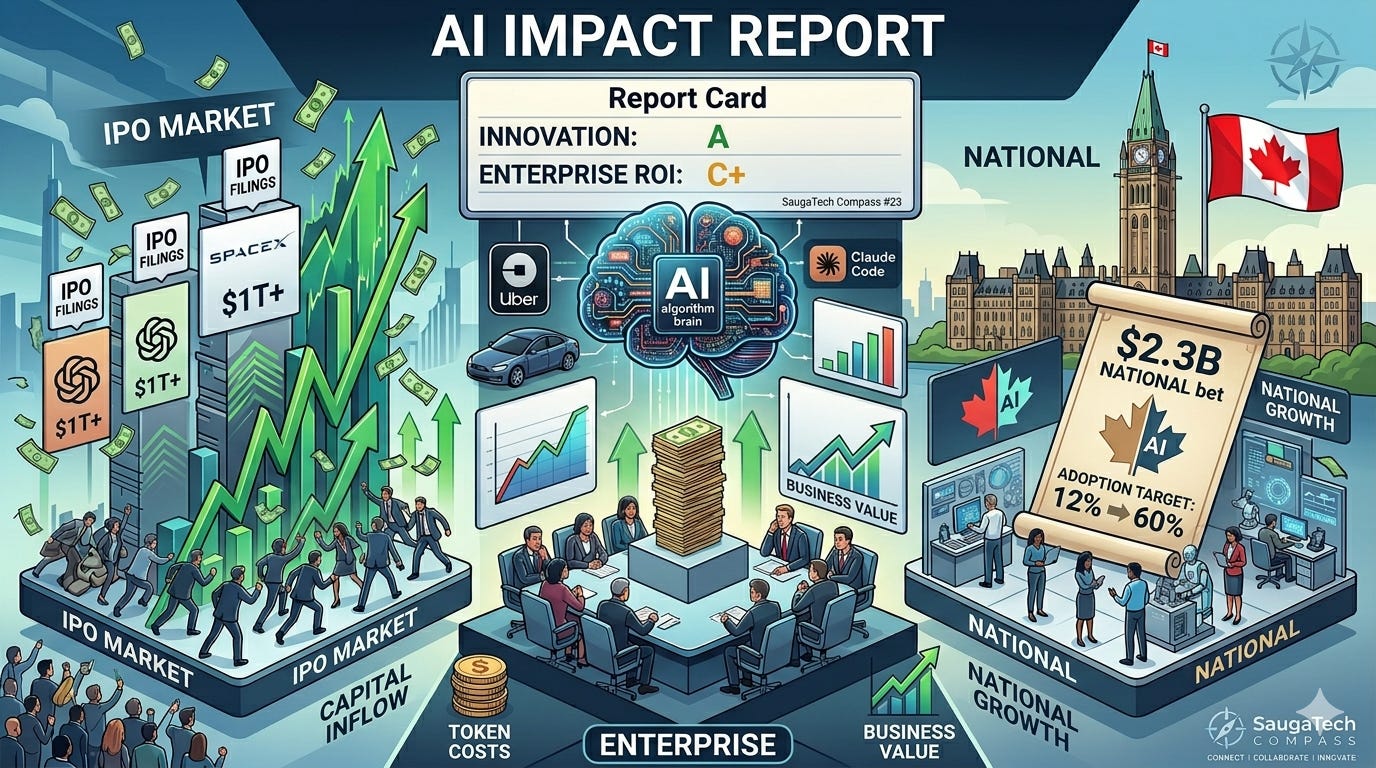
Three things happened in the last ten days that each answer the “what is AI worth?” question differently. A historic IPO priced. An enterprise cost crisis deepened. And Canada placed a $2.3 billion national bet. Same question. Three very different answers.
Grab a coffee. Let’s get into it.
🚀 First Things First: June 20 Meetup
We’re back at IDEA Mississauga, our theme this time is Building Secure Tech Products in the AI Era. Aries Youssefian and Samiul Islam open the session from architecture and prompt engineering perspectives, then we open it up to the room.
Post-pizza, we have a Builders Showcase — three 10-minute slots for community members to share what they’re building. Startup, side project, personal tool — anything real goes.
📅 Saturday, June 20, 2026
📍 IDEA Square One, Mississauga
🕐 1:00 PM – 3:00 PM (Doors open 12.30 pm)
Grab a spot if you haven’t already, we are almost at capacity.
More details & RSVP Here
Now coming back to the AI RoI question that we are trying to find answers to.
What Markets Say: The AI IPO Queue Is Open For Business
Something remarkable happened this week that got a little lost in the World Cup noise.
On June 1, Anthropic filed confidentially with the SEC for an IPO, targeting an October 2026 listing at a valuation of approximately $965 billion — just days after closing a $65 billion funding round that pushed it ahead of OpenAI in private market value for the first time. Days later, on June 8, OpenAI followed — filing its own confidential IPO paperwork, reportedly targeting September at a valuation approaching $1 trillion. And this Thursday, June 12 — the same day Canada plays its World Cup opener — SpaceX debuts on the Nasdaq at $135 a share, a market cap of $1.75 trillion, raising $75 billion in the largest IPO in history.
Three of the most powerful AI entities on the planet. Three IPOs. All within months of each other.
Now here is the part nobody is saying loudly enough.
OpenAI currently projects a $14 billion operating loss in 2026 alone, with no profitability expected until around 2029 or 2030. For every dollar it earns, it spends $2.22. Anthropic’s revenue trajectory is striking — annualised revenue grew from $10 billion last year to $47 billion by May 2026 — but with a $65 billion funding round just closed and billions more committed to AWS infrastructure, its burn rate is not modest either.
So why are they all going public now?
The honest answer is: because they have to. Private funding rounds at these scales have a ceiling. The infrastructure commitments these companies have made are staggering — OpenAI alone has committed to the $500 billion Stargate program, a $300 billion Oracle capacity agreement, and a $250 billion Azure services commitment through 2032. You cannot fund that from venture capital indefinitely. Public markets are the next pool of capital large enough to keep the machines running.
This is not cynicism — building frontier AI genuinely requires this kind of investment. But it is worth being clear-eyed about what these IPOs actually are. They are not exits for founders who have built profitable businesses. They are capital raises for companies spending enormously in the belief that the returns will eventually justify it. The public market investor is being asked to fund the gap between where these companies are today and where they need to be by 2030.
Markets will almost certainly say yes on Thursday. The question that connects directly to what enterprises are experiencing on the ground is whether the revenue to justify those valuations actually materialises. And that depends on something the IPO roadshows are spending surprisingly little time on: whether enterprises can figure out how to generate real, measurable ROI from AI before the patience of public market investors runs out.
What Enterprises Are Paying: The Token Bill Nobody Budgeted For
Here’s something that sparked a real debate recently in the tech circles.
Uber burned through its entire 2026 AI coding budget by April.
Not December. April.
The company had rolled out Claude Code to 5,000 engineers in December 2025. By April, 70% of code commits were AI-driven. And yet Uber’s COO admitted he couldn’t draw a direct line between rising token consumption and the consumer features actually being shipped.
“If you’re not actually able to draw a direct line to how many useful features and functionality you’re shipping to your users, that trade becomes harder to justify.”
This is the enterprise AI cost crisis that nobody is writing about in the same breath as trillion-dollar IPOs — but probably should be. Per-token prices have actually fallen 98% since 2022. Yet enterprise AI bills have risen by an estimated 320%. The cheapest production models cost around $0.04 per million tokens. The most expensive frontier reasoning models cost upward of $180 per million tokens. That is a 4,500x pricing spread. Most enterprises are defaulting to the most capable model for every task with minimal governance, routing logic, and no cost visibility.
The core problem is that tokens are nothing like the software seats enterprises have been buying for decades. Tokens scale nonlinearly. In agentic workflows — where AI is calling other AI, looping through tasks, generating intermediate outputs — a simple linear workflow that cost $0.04 per interaction in 2023 now costs roughly $1.20 in an orchestrated agentic system — about 30 times more. The pilot that looked affordable at 10 users becomes unrecognizable at 1,000.
Now connect this back to the IPO story. OpenAI and Anthropic are asking public markets to fund years of losses on the belief that enterprise AI spending will compound massively. But the enterprises that would generate that revenue are currently discovering their AI budgets don’t stretch as far as they thought. A Gartner study found that even as inference costs fall 90% by 2030, cheaper tokens won’t translate to cheaper enterprise AI — because agentic models require far more tokens per task, and providers won’t fully pass through lower costs. Something has to give — either enterprise ROI becomes demonstrable, or the trillion-dollar valuation story becomes very hard to sustain.
What Canada Just Decided: A $2.3 Billion National Bet
Last Thursday, June 4, Prime Minister Carney stood in Toronto and launched AI for All — Canada’s national AI strategy. The strategy contains $2.3 billion in spending and sets a goal of increasing Canadian business AI adoption from 12% to 60% by 2034.
Read that again. Twelve percent.
Canada — home to Geoffrey Hinton, Yoshua Bengio, and the foundational research that made modern deep learning possible — currently has only 12% of its businesses using AI tools. While Canada has world-class talent and one of the fastest-growing digital sectors in the G7, it is among the slowest countries to adopt AI at scale. This gap risks driving Canadian talent and startups abroad, and leaving critical parts of the ecosystem under foreign control.
The strategy’s most striking element isn’t the spending — it’s the structure. Canada will take equity stakes in its most promising AI firms, accelerating the creation of national champions. The $500 million Canadian Tech Growth Fund will provide growth capital and occasional federal equity investment in Canadian AI companies — with the explicit goal of keeping Canada’s best companies Canadian rather than watching them scale abroad.
The mixed reviews are fair. Critics note the strategy is light on concrete safety timelines and enforcement architecture, and the 12% to 60% adoption target spans eight years — mostly beyond any current government’s mandate. But the direction is clear. Canada looked at the SpaceX IPO, looked at the enterprise AI spending numbers, and decided: we are not going to be spectators in this transition.
For GTA founders, that is not nothing.
What This Means for Builders Across the GTA
Three answers to the same question. Taken together they point at something concrete for those of us building in Mississauga, Brampton, Oakville, and across the western GTA.
The valuation gap is a product opportunity. Markets pricing AI at $1.75 trillion while enterprises struggle with ROI creates a window. The companies that figure out how to deliver measurable, predictable AI value — not impressive demos but actual business outcomes with defensible unit economics — will be the ones that survive the inevitable valuation reckoning. That is a product problem. Product problems are solvable.
Token economics are the new unit economics. Your cost model is no longer seats times price. It is tokens times usage pattern times model choice. Founders who design for efficiency from day one — right model for the right task, not defaulting to the most expensive option — will have meaningfully better businesses than those who don’t.
Canada’s strategy is a door worth knocking on. The $500 million Canadian Tech Growth Fund will be looking for companies to back. A government mandate to take Canada from 12% to 60% AI adoption means there is real demand for companies that help Canadian businesses use AI effectively. For GTA founders with real enterprise traction, this is worth paying attention to.
The ROI conversation is ours to lead. Most Canadian businesses haven’t made their AI decision yet. The 12% adoption number tells us the room is still mostly empty. The people who show up with honest, grounded thinking about what AI delivers and what it actually costs will shape that conversation. Being informed in a room where most people aren’t is a genuine advantage — and it is exactly what this community is built to provide.
✨ SaugaTech Epilogue
On Thursday, when SpaceX starts trading on the Nasdaq and Canada runs out for its World Cup opener at BMO Field, two very different kinds of bets will be placed at almost the same moment.
One bet is on AI transforming everything, at $1.75 trillion. The other is on a team playing at home for the first time.
Both carry the same underlying belief: that showing up prepared, on the right stage, at the right moment matters. That the gap between where you are and where you could be is real — but crossable.
OpenAI is projecting a $14 billion loss this year. Anthropic is burning through billions while racing to go public. Neither is profitable. Both are betting that the enterprise ROI story gets written in their favour before public market patience runs out. They might be right. The infrastructure they’re building is genuinely extraordinary.
But the enterprises paying the token bills, the Canadian businesses sitting at 12% adoption, and the GTA founders figuring out their unit economics — they are the ones who will actually write that ROI story. Not in S-1 filings or on Nasdaq roadshows. In real workflows, real products, and real decisions made in real organizations.
That’s the ground level. And that’s where this community operates.
See you on June 20. And go Canada. 🍁⚽
Let’s keep building, Let’s keep learning, Together.
Team SaugaTech
CONNECT | COLLABORATE | INNOVATE