
🧭 SaugaTech Compass #18 - The OpenClaw Saga: How One Developer Beat Big Tech (And What It Means for Us)

Hi SaugaTech Community,
Last Thursday, someone in our WhatsApp group asked a simple question: “Has anyone tried ClawdBot? Just connected it to my Telegram and it seems quite interesting”. Within an hour, the thread had 40+ messages. People were debating whether to install it, sharing concerns about the security warnings, discussing how to sandbox it properly, basically how to get it working with minimum risk.
The conversation perfectly captured the tension: this thing looked incredible, but can we trust it?
Even if you missed that discussion, chances are someone in your techie circle mentioned OpenClaw. Maybe you saw the GitHub star chart that broke the internet. Maybe you read about the Austrian developer who joined OpenAI on Valentine’s Day. Maybe you just wondered why everyone keeps talking about lobsters.
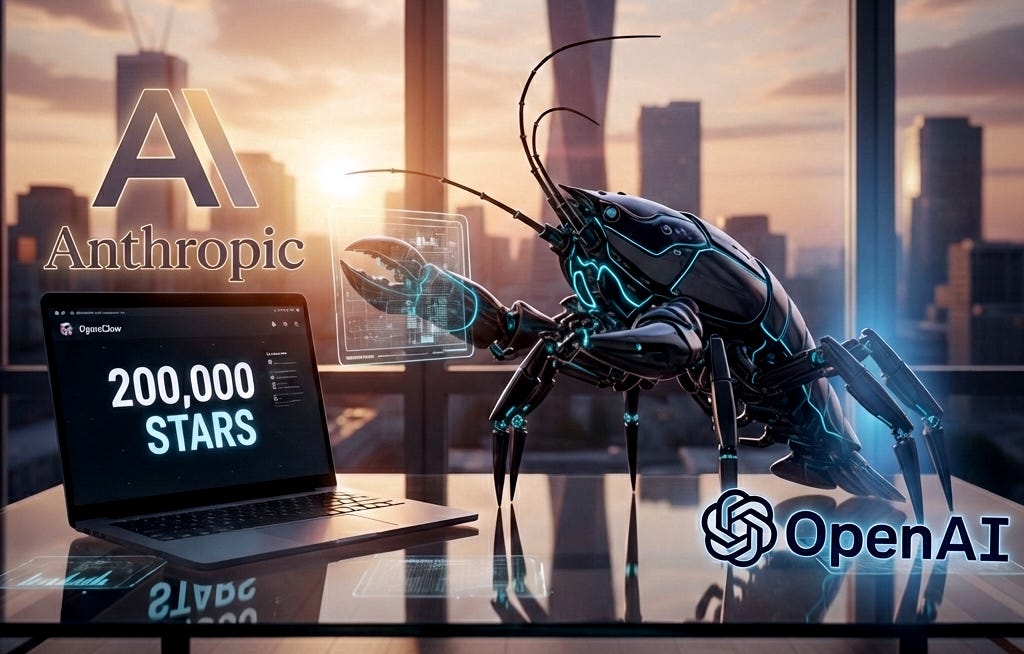
Here’s what actually happened: A solo developer built a weekend project that gained 200,000+ GitHub stars in 10 weeks—faster than Linux, Kubernetes, or any open-source project in history. Anthropic tried to shut it down with trademark complaints. Crypto scammers hijacked the name and launched a fake $16 million token. Security researchers called it a nightmare. And OpenAI swooped in, hired the developer, and turned what could have been a legal mess into their strategic advantage.
This is the story of ClawdBot, Moltbot, and OpenClaw. It’s about how Anthropic missed a trick, how OpenAI capitalized on that mistake, and what it all means for those of us building in the GTA.
🚀 First Things First: Join the Community
Before we dive in, quick reminder:
We’re planning our next meetup, write to us at saugatechproduct@gmail.com if you want any specific topic to be covered or want to volunteer as a speaker
Follow our journey on Linkedin, we just posted about the great event we had at IDEA Mississauga about Building your first AI Agent.
If you’re on whatsapp, join the SaugaTech WhatsApp Group to stay in the loop
Back to ClawdBot now.
The Beginning: A Weekend Hack in Vienna
Peter Steinberger is not your typical developer. He bootstrapped PSPDFKit—a PDF SDK company—for 13 years without venture capital and sold it for over €100 million in 2021. Then he took three years off and got bored.
In November 2025, he started tinkering with AI agents. Not the conversational chatbots everyone was building. Actual agents that could do things—read your emails, manage your calendar, execute terminal commands, control your computer.
He called it “WhatsApp Relay.” The idea was simple: message an AI through WhatsApp, and it would perform tasks on your home computer. He named it ClawdBot—a playful pun on Anthropic’s Claude, which powered the reasoning layer.
It was project number 44. The previous 43 had gone nowhere.
This one was different.
The Viral Explosion
By late January 2026, ClawdBot had crossed 9,000 GitHub stars. Then something wild happened. Matt Schlicht launched “Moltbook”—a satirical social network exclusively for AI agents. OpenClaw agents started creating profiles, friending each other, and generating content. The internet lost its mind.
Within days, ClawdBot was gaining 710 stars per hour. Over one weekend, it added 34,168 stars. The project drew 2 million visitors in a single week. By mid-February, it had crossed 200,000 stars and 36,000 forks.
Users created 1.5 million AI agents on the platform. Developers were running OpenClaw instances that could book flights, manage spreadsheets, debug code, and coordinate across WhatsApp, Telegram, Slack, and Discord.
What started as a passion project was suddenly turning into a global infrastructure.
Anthropic’s Legal Move (And the Backfire)
On January 27, 2026, Anthropic’s legal team sent Steinberger a trademark complaint. “ClawdBot” was too close to “Claude.” They asked him to rename it.
Steinberger didn’t fight. He understood trademark law. At 5 AM, in a chaotic Discord brainstorm with the community, they settled on “Moltbot”—a reference to how lobsters shed their shells to grow.
The rebrand to Moltbot lasted three days. The community hated the name. “It never quite rolled off the tongue,” Steinberger later wrote. On January 30, he renamed again—this time to OpenClaw. Domains secured. Trademark searches cleared. MIT license formalized. The project was now positioned as “model-agnostic agentic infrastructure.”
Here’s where Anthropic’s legal move backfired spectacularly.
By forcing the rebrand, they severed the association between OpenClaw and Claude. What started as a project built on top of Anthropic’s API became a platform-agnostic tool that worked with OpenAI, DeepSeek, Google, and anyone else. Anthropic turned a brand ambassador into a competitor.
And OpenAI was paying attention.
OpenAI’s Strategic Play
While Anthropic was sending cease-and-desist letters, OpenAI was watching OpenClaw become the fastest-growing repo in GitHub history.
They saw what Steinberger had built: a fully autonomous agent platform that ran locally, worked across messaging apps, and had already created 1.5 million agent instances. This wasn’t vaporware. This was production infrastructure with real users solving real problems.
On February 14, 2026—Valentine’s Day—Peter Steinberger announced he was joining OpenAI. The deal was elegant. Steinberger would lead OpenAI’s personal agent development. OpenClaw would transition to an independent open-source foundation. OpenAI would sponsor the project and commit to keeping it open. Steinberger retained creative control over the community.
OpenAI turned Anthropic’s legal enforcement into a hiring opportunity. They got the developer, the community, the momentum, and the positive PR of supporting open source. All while Anthropic’s lawyers were still drafting trademark complaints.
The Open Source Win
Strip away the corporate drama for a second. The real story here is what open source just proved.
One developer, working alone, using AI agents to write code, built infrastructure that rivaled proprietary products from billion-dollar companies. He did it in 10 weeks. He had no team, no VC funding, no marketing budget.
And he gained 200,000+ GitHub stars—more than Linux, Kubernetes, or TensorFlow gained in their first year.
OpenClaw now runs on local hardware. It’s privacy-conscious. It’s extensible. And it’s community-driven. Over 1,000 developers have contributed code. Thousands more have built “skills”—modular plugins that extend what the agent can do.
Yes, there were security issues. Researchers found vulnerabilities. Cisco called it a nightmare. Gartner issued warnings. China’s Ministry of Industry issued a public alert.
But none of that slowed adoption. People kept installing it. Because the value was real.
The market spoke: developers want agents that do things, and they want them now. They’re willing to trade some security risk for functionality, especially when they control the infrastructure.
This is what winning looks like for open source in 2026.
What This Means for Builders in the GTA
The OpenClaw saga offers three lessons that matter for those of us building in Mississauga, Toronto, Brampton, and across the GTA.
1. If Steinberger Can, We Can Too
Peter Steinberger is not superhuman. He built 43 projects that went nowhere before project 44 took off. He didn’t have insider access or special compute. He just used publicly available LLMs and built something people wanted.
There’s nothing stopping someone in Mississauga from doing the same thing. The tools are identical. The APIs work the same. The open-source ecosystem is global.
Steinberger isn’t alone. Look at what solo developers have already done:
Pieter Levels (Dutch) built Nomad List, Photo AI, and RemoteOK—generating $3M+ annually—completely solo. No team. No VC funding. Just PHP, a laptop, and relentless shipping. He launched 40+ projects before finding what worked. His competitive advantage? Shipping before things are ready and iterating based on real usage.
Maor Shlomo built Base44—an AI-powered no-code app builder—in six months and sold it to Wix for $80 million. Solo founder. No VC. He shipped 13 updates per day in the early weeks, got to 10,000 users in month one through virality, and reached profitability while scaling.
The pattern is clear: execution and taste beat resources. Steinberger understood what developers needed because he was solving his own problem first. He iterated fast. He built in public and let the community shape the product.
That playbook works here. You don’t need to be in Silicon Valley. You don’t need $100 million in funding. You need to understand a problem deeply, build a solution fast, and ship it where your users already are.
2. Open Source Is a Moat
When you open-source a project that solves a real problem, you’re not just sharing code—you’re creating a movement. Contributors fork it, build plugins, evangelize it, and defend it.
That’s what happened with OpenClaw. When Anthropic forced the rebrand, the community rallied. When scammers launched the fake token, the community exposed it. When security researchers issued warnings, the community hardened the code.
Open source done right creates defensibility that proprietary companies can’t match.
3. Platforms Will Try to Co-Opt You
OpenAI didn’t acquire OpenClaw. They hired Steinberger and committed to keeping the project open. They get the talent, the goodwill, and the association with the fastest-growing repo in GitHub history—without shutting down a beloved open-source project.
For builders: if you build something valuable on someone else’s platform, they will eventually try to co-opt you through acquisition, copying, or hiring. The question is whether you retain enough control to negotiate from strength.
Steinberger did. OpenClaw remains open. The foundation is independent. The community continues. That’s the goal.
The Epilogue: What Happens Next
OpenClaw is now transitioning to an independent foundation. Steinberger is at OpenAI working on personal agents. The community is building faster than ever.
Anthropic, meanwhile, is facing questions about why they enforced a trademark claim that ultimately benefited their biggest competitor. The legal team was probably just doing their job. But the strategic outcome was disastrous.
OpenAI, on the other hand, just hired one of the most productive developers in the AI space and secured goodwill with the open-source community. All while their competitor handed them the opportunity.
For those of us in the GTA watching this unfold, the takeaway is simple: the barriers to building world-class software are lower than ever. One person with taste, execution speed, and a deep understanding of their users can create infrastructure that competes with billion-dollar companies.
Peter Steinberger did it from Vienna. Someone in Mississauga, Toronto, or Brampton could do it next.
The tools are here. The community is here. The only question is who’s building.
Let’s keep building, Let’s keep learning, Together.
Team SaugaTech
CONNECT | COLLABORATE | INNOVATE
Excellent breakdown of the OpenClaw saga. What's missing from most coverage is the paying user perspective — what it actually felt like from the inside to be a $2,600/year Claude Max subscriber watching Anthropic mishandle this.
The C&D was just one incident in a longer pattern that eroded trust with Anthropic's most invested users. A long-time paying subscriber documented the full arc — including the 6-month window where the $16M crypto scam using Anthropic's name ran unchallenged, the dropped RSP safety pledge, and how each incident compounded until they cancelled: https://aiwithapexcom.substack.com/p/after-nearly-a-year-on-claude-max
Your observation that "by forcing the rebrand, they severed the association between OpenClaw and Claude" is exactly right from the business side. But there's a human side too: the developers who built on Claude in good faith, paying hundreds per month, felt that same severance.