
🧭 SaugaTech Compass #17 - The Brex-Ramp Story - Why Execution Beats First-Mover Advantage

Hi SaugaTech Community,
If you grabbed coffee in Liberty Village or Mississauga this week and overheard people talking about the Brex acquisition, you probably heard two reactions. First: “Wow, $5 billion exit.” Second: “Wait, didn’t they raise at $12 billion?”
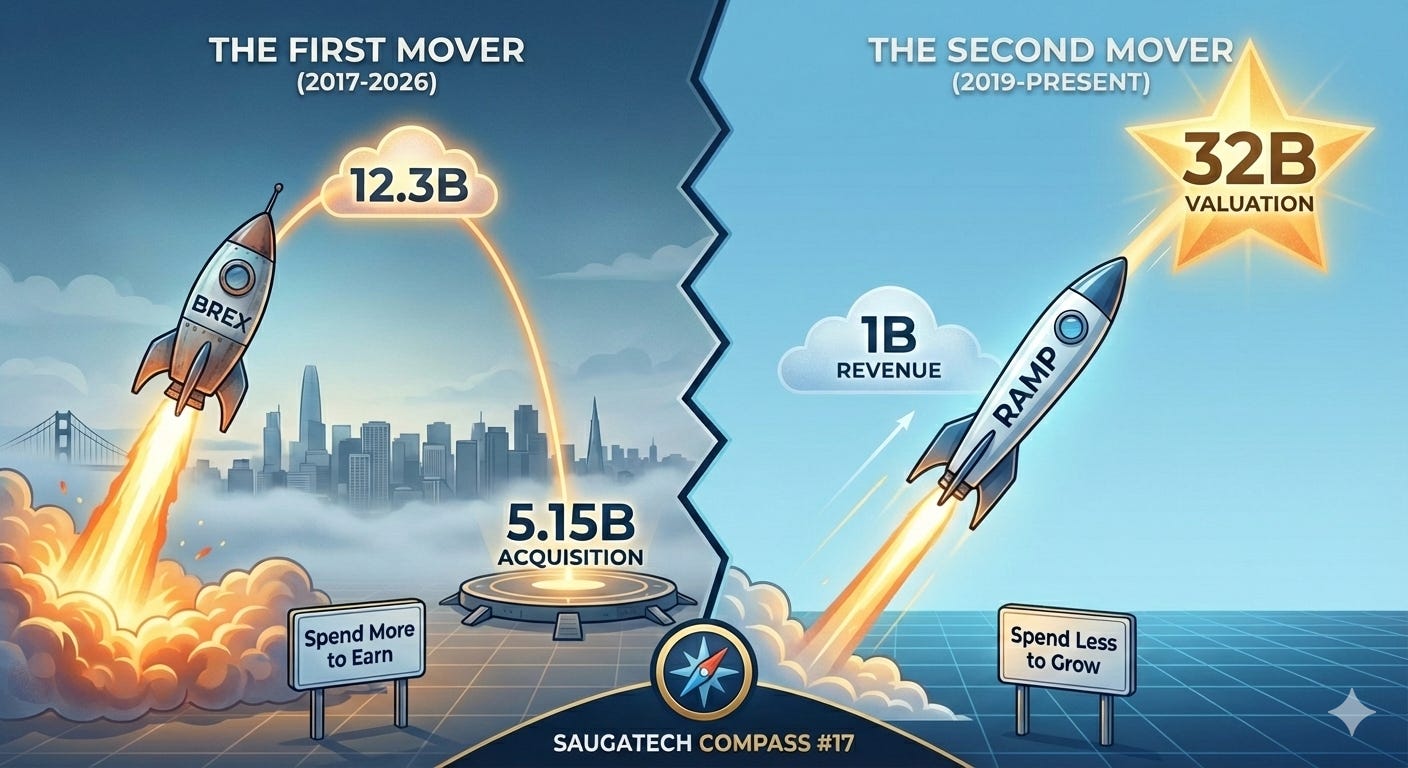
Both reactions are right. But there’s a bigger story underneath those numbers. While Brex sold for less than half its peak valuation, Ramp—the company that entered the market two years later as the “second mover”—now sits at a $32 billion valuation with over $1 billion in revenue. They didn’t just catch up. They lapped the competition entirely.
For those of us building B2B SaaS in the GTA, this is a masterclass in founder resilience, strategic differentiation, and how doing one thing exceptionally well beats trying to do everything at once.
Grab a fresh brew. We’re dissecting the $7 billion haircut, how Ramp beat them to the post and the learning every B2B SaaS founder can take away from the journey.
🚀 First Things First: Beyond the Prompt (Feb 7th meetup @ Square One, Mississauga)
Before we dive into the saga, a quick community sync for our local builders.
The era of the “Prompt Engineer” is almost over. In 2026, the world has moved from Chat to Agentic Workflows. Join us for our next meetup to brainstorm how SaugaTech community is navigating this shift.
Beyond the Prompt: Building Your First AI Agent
A hands-on meetup to make AI agents easy to understand and even easier to build.
📅When - Saturday, February 7, 2026
📍Where - IDEA Square One (IDEA Mississauga)
💡Who should attend : Anyone who has heard about AI agents and wants to understand how to get started with them, without the jargon
More details in event RSVP link, Register here
Two Founders, Two Approaches
In 2017, Henrique Dubugras and Pedro Franceschi founded Brex driven by a personal insight: As a startup, they couldn’t get corporate credit cards because banks underwriting based on personal credit scores. They built software to assess real-time financial health using bank data. If you had venture funding, you got a card in minutes with 10x higher credit limits than traditional banks.
The model exploded. By early 2022, Brex hit a $12.3 billion valuation. They were the darling of Silicon Valley, backed by Peter Thiel and Y Combinator, with thousands of customers and triple-digit revenue growth.
Two years behind them, in 2019, Eric Glyman and Karim Atiyeh launched Ramp. They’d already sold their first company, Paribus, to Capital One. They could have built anything. Instead, they chose to go head-to-head with Brex in corporate cards.
Everyone called them the “second mover.” Glyman’s response: “We always thought we were the 150th mover. When you think about companies, most of the juggernauts in this country started 175 years ago.”
The difference wasn’t timing. It was strategy.
Credit vs. Cost Reduction
Brex’s model was elegant: give startups credit they couldn’t get elsewhere, collect interchange fees on their spending, and build a financial platform on top of that wedge. The entire industry worked this way—incentivize customers to spend more, collect margins, minimize rewards costs.
Ramp took the opposite approach. Their mission statement: “Help our customers spend less.”
That wasn’t marketing speak. It was the entire business model. Ramp built their entire platform around ability to find duplicate subscriptions, negotiate vendor discounts, flag unusual spending patterns, and automate expense reporting so thoroughly that companies saved an average of 5% on total spend.
This created a fundamentally different relationship with customers. Traditional corporate cards make money when you spend more. Ramp makes money when you spend smarter. The incentives were finally aligned.
While Brex Pivoted, Ramp Sprinted
In 2022, the market turned. Interest rates spiked. VC funding dried up. Startups stopped burning cash and started cutting costs. Brex’s interchange revenue fell as customer spending slowed. They were burning $17-22 million per month with unit economics that suddenly didn’t work.
In June 2022, Brex made a painful decision: they exited the SMB market entirely. They cut roughly 40,000 small business customers to focus on larger, venture-backed companies. The backlash was brutal. Small business owners felt abandoned. Competitors seized the opening. In January 2024, Brex laid off 20% of their workforce to reduce burn. By mid-2024, they’d cut costs by 70% and recovered to around $700M in revenue. They were rebuilding, but momentum was lost.
During that same period, Ramp went from strength to strength. By January 2024, they’d overtaken Brex in total payment volume—$30 billion annualized compared to Brex’s declining numbers. By September 2025, Ramp crossed $1 billion in revenue and became cash-flow positive. They raised at $8.1B in March 2022, $16B in summer 2024, and $32B just eight weeks later.
The market was punishing growth-at-all-costs and rewarding sustainable execution. Ramp had built for that reality from day one.
The Secret Weapon - Execution Speed
Ramp didn’t just have a better value proposition. They executed faster than anyone thought possible.
The company counts days, not months or quarters. They’re currently on day 2,367 since founding. Every board meeting starts with that number. Glyman explains: “It’s a forcing function. If we’re on day 1,866, we ask: are we shipping like a company that’s 1,866 days old?”
The results speak for themselves. With a team of 10 people and eight engineers, they built a competitor to American Express in three months. Six months later, they built a competitor to Expensify. Then they moved into accounts payable with three engineers, one designer, and one PM—and shipped it in three months.
When Brex famously "fired" their SMB customers in 2022 to fix their unit economics, the backlash was nuclear. Ramp didn't just run ads; they overnight built a "Brex Migrator" tool and welcomed the abandoned SMBs with open arms. They captured thousands of high-growth companies that Brex deemed "unprofitable," proving that in B2B SaaS, your customer base can be your greatest constraint or your greatest moat.
The Difference: Customer Retention as Moat
Here’s the number that matters most: in 2024, 12,059 customers signed up for Ramp. Only 8 churned. That’s a 99.93% retention rate.
You don’t get numbers like that from clever marketing or aggressive sales. You get them by building a product so good that switching back to anything else feels like a downgrade.
Ramp saves companies real money. They automate expense reports so thoroughly that what used to take an hour takes 10 seconds. They negotiate vendor discounts automatically. They catch duplicate SaaS subscriptions. They integrate with accounting systems so seamlessly that CFOs wonder how they ever lived without it.
Brex focused on giving startups credit they couldn’t get elsewhere. That’s valuable—until every other fintech company offers the same thing. Ramp focused on making their customers’ businesses run better. That’s defensible. That’s real moat.
What This Teaches Us About Resilience
The Ramp story offers lessons that matter for anyone building in the GTA.
Being second isn’t a disadvantage if you learn from the first. Glyman and Atiyeh spent their time at Capital One studying what worked and what didn’t. They talked to 150+ founders and CFOs before writing a line of code. They validated real pain points and built early demand. When they launched, they weren’t guessing—they knew exactly what customers needed.
Your differentiation has to be structural, not cosmetic. Brex and Ramp both offered corporate cards. The difference was what they optimized for: spend more vs. spend less. That core difference shaped everything—product roadmap, sales motion, customer incentives. You can’t copy that with a feature update.
Speed compounds. Ramp’s obsession with shipping fast meant they could test, iterate, and improve faster than competitors. By the time Brex was restructuring in 2023-2024, Ramp had already built and deployed the next generation of features. Velocity matters more than most founders realize.
Retention beats acquisition. A 99.93% retention rate means you’re not constantly replacing churned customers. Every new customer adds to the base instead of backfilling losses. That creates compounding growth that’s nearly impossible to compete with.
Aligning incentives with customers creates durable moats. When you make money by helping customers succeed rather than maximizing their spending, you build trust that’s hard to break. Customers become advocates because you’re genuinely on their side.
✨SaugaTech Epilogue
The Brex | Ramp story is a reminder that markets reward resilience more than timing. They reward clarity over complexity. They reward customer obsession over growth theater.
Glyman and Atiyeh entered a market where competitor already had a multi-billion-dollar valuation and deep investor backing, everyone said they were too late. They didn’t blink. They built a company that now defines the category. The secret wasn’t luck or timing—it was doing one thing exceptionally well and refusing to compromise on execution speed. They focused on execution, trusted their differentiation, and outlasted everyone.
For those of us in the GTA building the next generation of B2B SaaS companies, the lesson is clear. Pick your wedge carefully. Understand what customers actually need, not what sounds impressive. Build faster than anyone thinks possible. And align your incentives with customer success so completely that choosing anyone else feels like settling.
Let’s keep building, Let’s keep learning, Together.
See you at IDEA Mississauga, Square One on 7th Feb.
Team SaugaTech
CONNECT | COLLABORATE | INNOVATE