
🧭 SaugaTech Compass #15 - Eight Tech predictions that we think will define 2026

Hi SaugaTech Community,
Welcome back and wish you all a very Happy New Year.
If you’re reading this on the GO train heading into downtown or grabbing coffee between meetings in Mississauga, you already know the feeling—that slightly disorienting return to routine after the holidays. The Slack channels are buzzing again, the inbox has multiplied, and somewhere between your third coffee and your first “quick sync,” you’ve realized we’re not easing into 2026. We’re already sprinting.
The tech landscape is shifting in ways that go well beyond just smarter chatbots. We’re seeing a fundamental rethink of where compute happens, how money moves, and what constitutes defensible infrastructure. And for those of us building in the GTA—whether you’re in a Waterloo startup, a Toronto scale-up, or a Mississauga enterprise—these shifts create opportunities that didn’t exist six months ago.
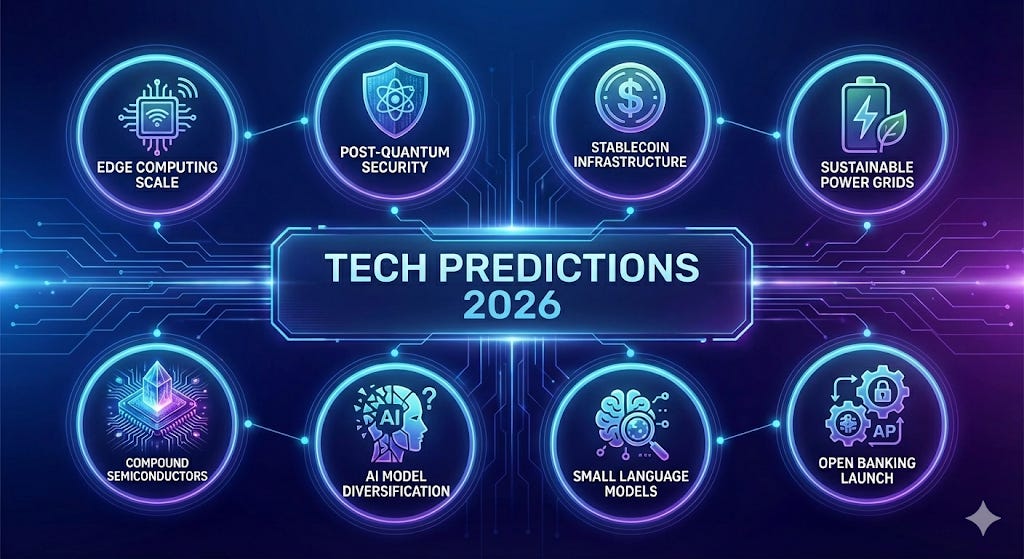
So before we get buried in Q1 OKRs and sprint planning, let’s map out what’s actually coming. In this edition of SaugaTech Compass, we are making eight predictions for 2026 that we think might shape the overall tech landscape and specially the Canadian tech ecosystem. Some of these predictions will land cleanly. Others will miss completely. We’ll revisit them throughout the year and see which ones held up.
📋 In This Edition:
🚀 First things First: Syncing the Community, SaugaTech Whatsapp Group
🧠Eight Tech predictions for 2026 : Gazing through the magic crystal ball
⚖️SaugaTech epilogue : Closing notes and what can we do as techies
🚀 First Things First: January Meetup Coming Soon
Before we dive into the predictions, a quick community update: we're planning our first SaugaTech meetup of 2026 for late January. We'll be making a formal announcement with details soon, but if you want to be in the loop for when registration opens, make sure you're in the SaugaTech WhatsApp Group—that's where the early announcements happen. This is where the real conversations happen—the tool recommendations, the “has anyone tried this yet” questions, the job postings that never make it to LinkedIn. Click here to join or scan the QR code below.

🧠SaugaTech’s Eight Tech predictions for 2026
1. ⚡ Edge Computing Ships at Scale
For years, edge computing has been “the next big thing.” In 2026, it stops being a prediction and starts being infrastructure.
Factories can’t afford cloud round-trips when a sensor detects bearing failure. Autonomous systems can’t function if the network drops. Medical devices need to make decisions locally. The economics are finally there: edge AI chips are affordable, 5G is mature, and streaming everything to the cloud costs too much.
Canadian opportunity: Our manufacturing sector—automotive, aerospace, materials—is positioned well for retrofitting operations with edge intelligence.
2. 🛡️ Post-Quantum Cryptography Stops Being Optional
The quantum threat has been theoretical for years. In 2026, it becomes a compliance requirement.
Government mandates are coming. NIST released the first post-quantum cryptographic standards in 2024, and by mid-2026, critical infrastructure and supply chains will need migration plans. The threat model is simple: adversaries are already capturing encrypted data today, planning to decrypt it once quantum computers are powerful enough.
The transition won’t be easy. Decades of work have gone into refining current encryption, and now we’re rewriting that with new standards. This will introduce bugs, performance overhead, and compatibility headaches.
Canadian angle: If you handle financial data, healthcare records, or government contracts, your encryption strategy needs to change this year.
3. 💰 Stablecoins Become Boring Infrastructure
Crypto has spent years trying to convince people it’s revolutionary. In 2026, stablecoins just become how money moves on the internet.
JPMorgan extended JPM Coin to public blockchains. Société Générale launched a euro stablecoin. When traditional banks are issuing blockchain tokens, the experiment is over. Stablecoins are becoming the rails for remittances, B2B payments, and cross-border settlement because they’re faster and cheaper. The breakthrough is that the technology becomes invisible—businesses use stablecoins without thinking about blockchains.
Canadian fintech angle: Canada’s position between U.S. and global markets creates natural cross-border payment opportunities.
4. 🔌 The Energy Crunch Reshapes Decisions
Data centers are hitting power limits. Microsoft committed $19 billion to Canadian AI infrastructure, but the bottleneck is energy availability. Utilities can’t add capacity as fast as data centers need it.
Energy is becoming a larger percentage of compute costs. Access to power is becoming a competitive advantage. Companies will choose where to build based on energy availability, not just tax incentives.
Canadian edge: Our hydroelectric capacity is unmatched—it’s our sovereign compute moat.
5. 🇨🇦 Canada’s Compound Semiconductor Bet Pays Off
While the U.S. and China fight over standard silicon, Canada has been building expertise in compound semiconductors—chips from gallium nitride and indium phosphide that handle extreme temperatures and high frequencies that silicon can’t match.
The FABrIC initiative ($223M over five years) starts delivering commercial products in 2026. These chips power 5G base stations, satellite systems, military radar, and AI accelerators. It’s a niche that plays to our research strengths without competing on volume manufacturing.
The payoff: Companies in photonics, quantum sensors, and specialized AI hardware are building infrastructure that takes years to replicate. Smaller market, better margins, mission-critical applications.
6. 🔥 OpenAI’s Existential Year
Here’s the uncomfortable truth: OpenAI is facing an existential crisis in 2026, and there’s a real chance they don’t come out on top.
DeepSeek just released models matching GPT-5 performance at a fraction of the cost—trained for $6 million versus OpenAI’s $100 million-plus. Google’s Gemini 3 overtook GPT-5 on key benchmarks, triggering Sam Altman’s internal “code red.” OpenAI’s enterprise market share dropped from 50% in 2023 to 27% today. ChatGPT traffic is declining month-over-month.
The company is reportedly seeking $100 billion at a $750 billion valuation while burning massive amounts of cash. They’re planning an IPO for late 2026, but the fundamental question hasn’t been answered: when does the investment pay off, and is there a bubble forming around the entire sector?
Why this matters: OpenAI pioneered the chatbot era, but pioneering doesn’t guarantee winning. The competitive moats they thought they had—massive compute, proprietary training, network effects—are eroding faster than expected. DeepSeek proved you don’t need billions in compute. Google proved you can catch up with multimodal integration. Meta and others are releasing competitive open-source alternatives.
The 2026 IPO will be the moment of truth. Either OpenAI proves they can turn massive usage into sustainable revenue and justify the valuation, or we’ll see one of the most spectacular flameouts in tech history. For builders, this means diversifying your AI stack now. Don’t build your entire business on a single provider that might not exist—or might not be affordable—in two years.
Canadian angle: This chaos creates opportunity for AI companies built around sovereign compute and data residency.
7. 💻 Small Language Models Become the Default
The mega-models are impressive, but they’re expensive and overkill for most tasks. In 2026, Small Language Models fine-tuned for specific domains become the norm. They’re faster, cheaper, and when trained properly, they outperform general-purpose models on specialized tasks.
AT&T and other enterprises are seeing this: SLMs match larger models in accuracy for specific use cases but cost a fraction to run. It’s the same pattern we saw with databases—start with the giant all-purpose solution, then specialize once you understand your actual needs.
Canadian edge: Our compute infrastructure still lags the U.S., but SLMs are less resource-intensive. A well-tuned 7B parameter model running on local hardware can compete with much larger models for specific applications.
8. 🏦 Open Banking Finally Launches (And Changes Everything)
After years of delays and consultations, Canada’s Consumer-Driven Banking Act goes live in early 2026. This isn’t just another regulatory update—it’s the foundation for a complete rebuild of how financial data moves.
Right now, about nine million Canadians share their banking passwords with fintech apps through “screen scraping”—a risky workaround where apps log into your bank account as if they were you. Open banking replaces this with secure APIs that let you control exactly what data gets shared and with whom. Phase 1 launches with read access in early 2026, and by mid-2027, we’ll have write access—the ability to initiate payments and switch accounts directly through third-party apps.
The Bank of Canada is now in charge of oversight, which signals the government is treating this as critical financial infrastructure, not just a nice-to-have for innovation.
Why this is your moment: For fintech builders, the entire financial services stack is being opened up for the first time. Companies that move fast on read access in 2026 will have an 18-month head start before write access enables payment initiation. Think about everything that becomes possible: instant loan applications that pull verified income data, investment apps that automatically rebalance based on spending patterns, credit building for renters whose on-time payments finally count toward their score.
The constraint won’t be technology—it’ll be understanding the problem well enough to build something people actually want.
✨SaugaTech Epilogue
If there’s a theme running through all of this, it’s that 2026 is the year infrastructure catches up to ambition—and the year we find out which bets actually pay off. The tools are good enough. The hardware is affordable enough. The policy environment in Canada is finally supportive enough. But execution still matters more than ideas, and not everyone who looks like a winner today will finish the race.
The open banking launch is the one I’m personally most excited about. For years, Canadian fintech has been hamstrung by infrastructure that belonged in 2005. Now we’re finally getting the rails to build something modern. The question is who moves fast enough to capture the opportunity.
For us as builders and tech professionals, the path forward is clearer than it’s been in years. Pick one or two of these trends and go deep. Don’t try to be an expert in everything—the winners will be the ones who understand their chosen domain better than anyone else. Whether that’s edge computing for manufacturing, open banking for fintech, or multi-agent systems for your specific vertical, depth beats breadth. Attend meetups, join communities like ours, share what you’re learning, and don’t be afraid to build in public. The opportunities are real, but they won’t wait for perfect timing.
Let’s keep building, Let’s keep learning, Together.
Team SaugaTech
CONNECT | COLLABORATE | INNOVATE